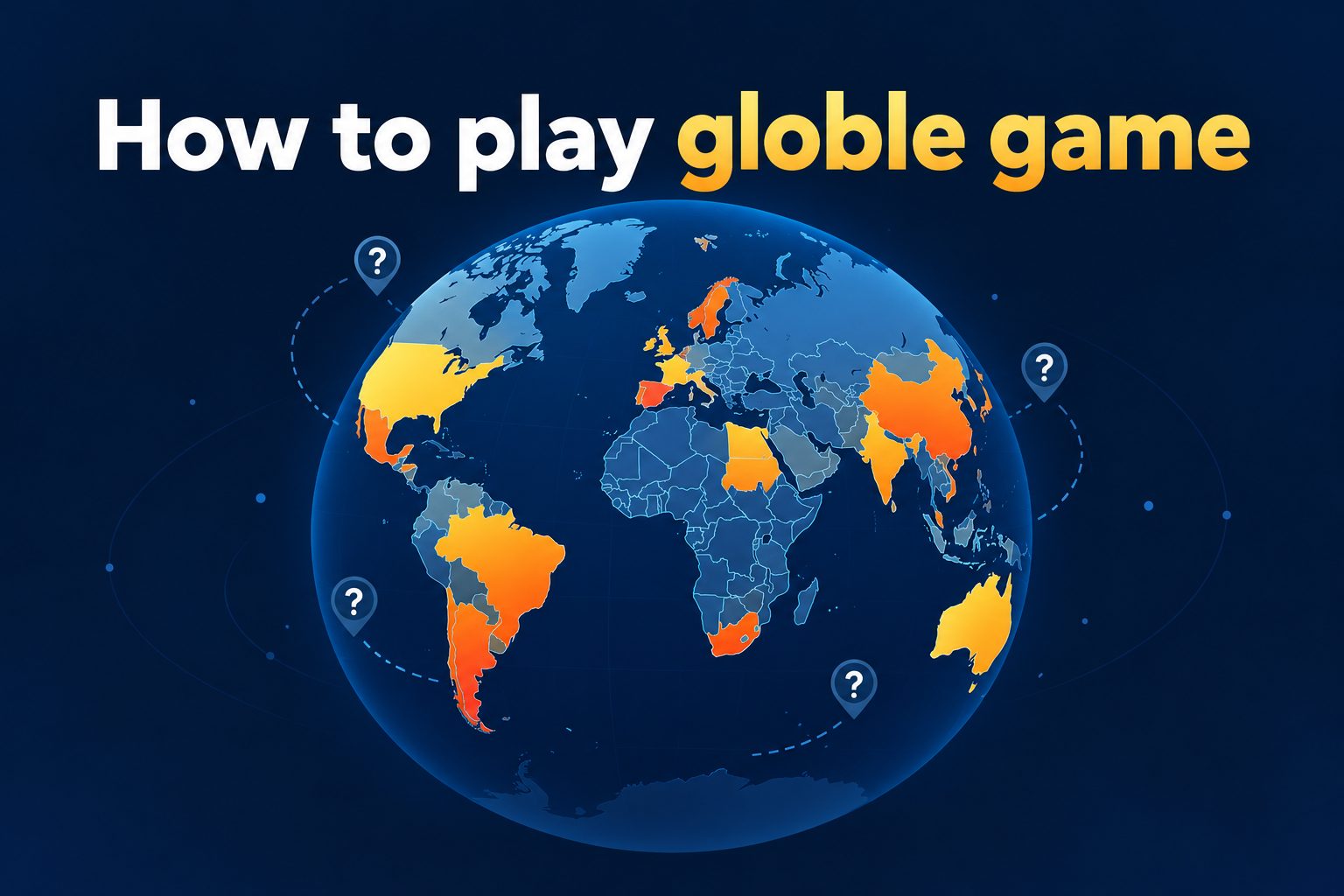
Learning how to play globle game is a fun way to test your geography knowledge without needing to memorize every capital city or flag. The goal is simple: find the mystery country in as few guesses as possible by using color clues and your sense of location.
Unlike many word games, Globle rewards spatial thinking. Each guess reveals how close your selected country is to the answer, so every attempt can teach you something about continents, borders, oceans, and regional patterns.
This guide explains the rules, a practical guessing method, useful examples, common errors, and smart habits that can help beginners enjoy the game while steadily improving their results.
Globle is a daily geography puzzle built around one hidden country. You enter country names, and the game responds with a color that represents the distance between your guess and the target country.
A cold color means your guess is far away. As guesses become geographically closer, the color becomes warmer. Very warm colors indicate that you are in the right part of the world, although the target may still be several countries away.
The puzzle is not mainly about political trivia. It is about using feedback to narrow a huge world map into a smaller and more logical search area. A good guess gives you useful direction even when it is incorrect.
Every player receives the same daily country, which makes the game easy to discuss with friends or classmates. However, the best experience comes from solving it yourself before comparing the number of guesses used.
There is no strict time pressure, so take a moment after each color clue. The more carefully you connect nearby countries, coastlines, and regions, the more satisfying the final answer becomes.
How Do You Play Globle Game Effectively?
1. Begin With A Broad Country Guess
Start with a large, centrally located country that helps divide the world into useful areas. Countries such as Brazil, Egypt, India, or Kazakhstan can provide broad directional information because they sit near several regions. Your first guess is not about being lucky; it is about creating a reliable starting point.
2. Read The Color Feedback Carefully
Treat each color as distance information rather than a simple right-or-wrong signal. A cool result means you should move far from that country, while a warm result suggests that nearby countries deserve attention. Compare each new shade with previous guesses before deciding your next move.
3. Move Toward The Warmest Result
Once one guess is warmer than the others, use it as your anchor. Look at countries around it and make a controlled move into the same continent, subregion, or neighboring coastline. Avoid jumping to another part of the world unless the color becomes noticeably colder.
4. Check Nearby Borders And Seas
When you are close to the answer, country borders matter more than continent-level knowledge. Think about which nations touch your warm guess and whether the target could be across a narrow sea or gulf. Island countries can be especially easy to overlook during this stage.
5. Use Directional Comparisons
Compare at least two recent guesses to estimate direction. For example, if a country to the east is warmer than a country to the west, continue exploring eastward instead of testing random neighbors. This comparison turns the game into a simple geography puzzle rather than a guessing contest.
6. Confirm Before Your Final Guess
When several countries seem possible, pause and review the surrounding map in your mind. Consider land borders, regional groupings, and relative position before entering another answer. A short review often prevents wasted guesses on countries that are close but clearly outside the strongest clue pattern.
Why Is The Globle Game Useful?
1. Geography practice becomes more memorable because every country name is connected to a visual distance clue and a real location on the map.
2. The game develops spatial reasoning by encouraging players to estimate where nations sit in relation to each other instead of recalling isolated facts.
3. Daily puzzles create a manageable learning habit. Even a short session can introduce unfamiliar countries, regions, and border relationships.
4. Players build confidence gradually because incorrect guesses still provide information. Each color result helps narrow the next decision.
5. Globle can support classroom discussion, family challenges, or personal study because people can compare strategies without needing advanced geography knowledge.
Key Clues For Solving Globle Puzzles
- Warm Colors: These show that your guess is geographically close to the hidden country, so investigate nearby nations before expanding your search.
- Cold Colors: These suggest that the target lies far away, making it sensible to shift continents or test a completely different world region.
- Neighboring Countries: Countries sharing a border with a warm guess are often the most efficient next options, especially when the target is landlocked.
- Coastal Position: A target may be near a warm country without sharing a border, particularly across narrow waters, straits, or island chains.
- Regional Knowledge: Knowing broad areas such as the Balkans, Horn of Africa, Central America, or Southeast Asia helps convert a warm clue into better choices.
- Guess History: Review earlier results instead of focusing only on the latest one. Several colors together create a much clearer picture of the target area.
Common Globle Game Mistakes To Avoid
1. Guessing Random Countries Repeatedly
Random guesses can occasionally work, but they rarely improve your geography skills or solve the puzzle efficiently. Make every entry answer a question, such as whether the target is north, south, inland, coastal, or located in a neighboring region. Intentional guesses create a useful chain of evidence.
2. Ignoring Earlier Color Results
Players sometimes chase the latest warm color and forget that earlier guesses may rule out whole parts of a continent. Keep a simple mental map of hot and cold areas. The answer should make sense in relation to all major clues, not only the most recent result.
3. Confusing Nearby Regions
Countries in similar regions can feel interchangeable, especially in areas with many small states. Slow down and recall which countries border one another. Learning a few regional clusters is more useful than trying to memorize the entire world map at once.
4. Forgetting Island Nations
A very warm mainland guess does not always mean the answer shares a land border. The target could be an island country nearby or separated by a narrow stretch of water. Consider regional islands whenever coastal guesses are consistently becoming warmer.
5. Switching Direction Without Evidence
Do not abandon a promising region after one imperfect guess. If the color remains relatively warm, test logical neighbors before moving thousands of kilometers away. Controlled movement is more effective than dramatic jumps because it reveals the direction of improvement.
6. Treating The Game As A Memory Test
You do not need perfect knowledge to enjoy Globle. Use the game to learn through reasoning, then notice unfamiliar countries after the answer appears. A curious approach reduces frustration and makes each daily puzzle a small, repeatable geography lesson.
Knowing how to play globle game starts with a simple idea: use distance colors to move from broad world regions toward nearby countries. Strong results come from thoughtful comparisons, not quick random entries.
Begin with useful anchor countries, follow the warmest clues, and check borders, coastlines, and regional patterns. Each puzzle will make your mental map a little sharper.
Do not worry about solving every daily challenge in very few guesses. The real value is learning how countries relate to one another while enjoying a calm and rewarding puzzle.
FAQs About the Globle Game
1. Is Globle game free to play?
Globle is generally designed as a simple daily browser puzzle, and players can usually begin without complicated setup. Availability and features can vary over time, but the central activity remains entering country guesses and using distance colors to identify the hidden country.
2. What Do The Colors Mean In Globle?
The colors indicate how geographically close your chosen country is to the target. Colder colors mean greater distance, while warmer colors mean you are closer. The color does not tell you an exact direction, so compare several guesses to work out where to search next.
3. Can I Play More Than One Puzzle Each Day?
The main version is commonly built around one shared daily puzzle. That format encourages players to compare results fairly. If you want more practice, review past country maps, use geography quizzes, or challenge yourself to trace neighboring countries after completing the day’s puzzle.
4. What Is The Best First Guess In Globle?
There is no guaranteed best opening country because the hidden answer changes every day. A large, recognizable country in a useful central region can be helpful because it quickly provides broad distance information. Choose an opening country you can place confidently on a map.
5. Do Countries Need To Share A Border To Be Close?
No, countries can be close without sharing a land border. Narrow seas, gulfs, and island chains can place countries near each other geographically. When a coastal country becomes warm, consider nearby islands and countries across water as well as direct land neighbors.
6. How Can Beginners Improve At Globle?
Beginners improve fastest by playing consistently and reviewing unfamiliar regions after each puzzle. Focus on continents first, then learn common border groups and island locations. Treat every incorrect guess as a clue, and use previous colors to guide the next choice instead of guessing at random.