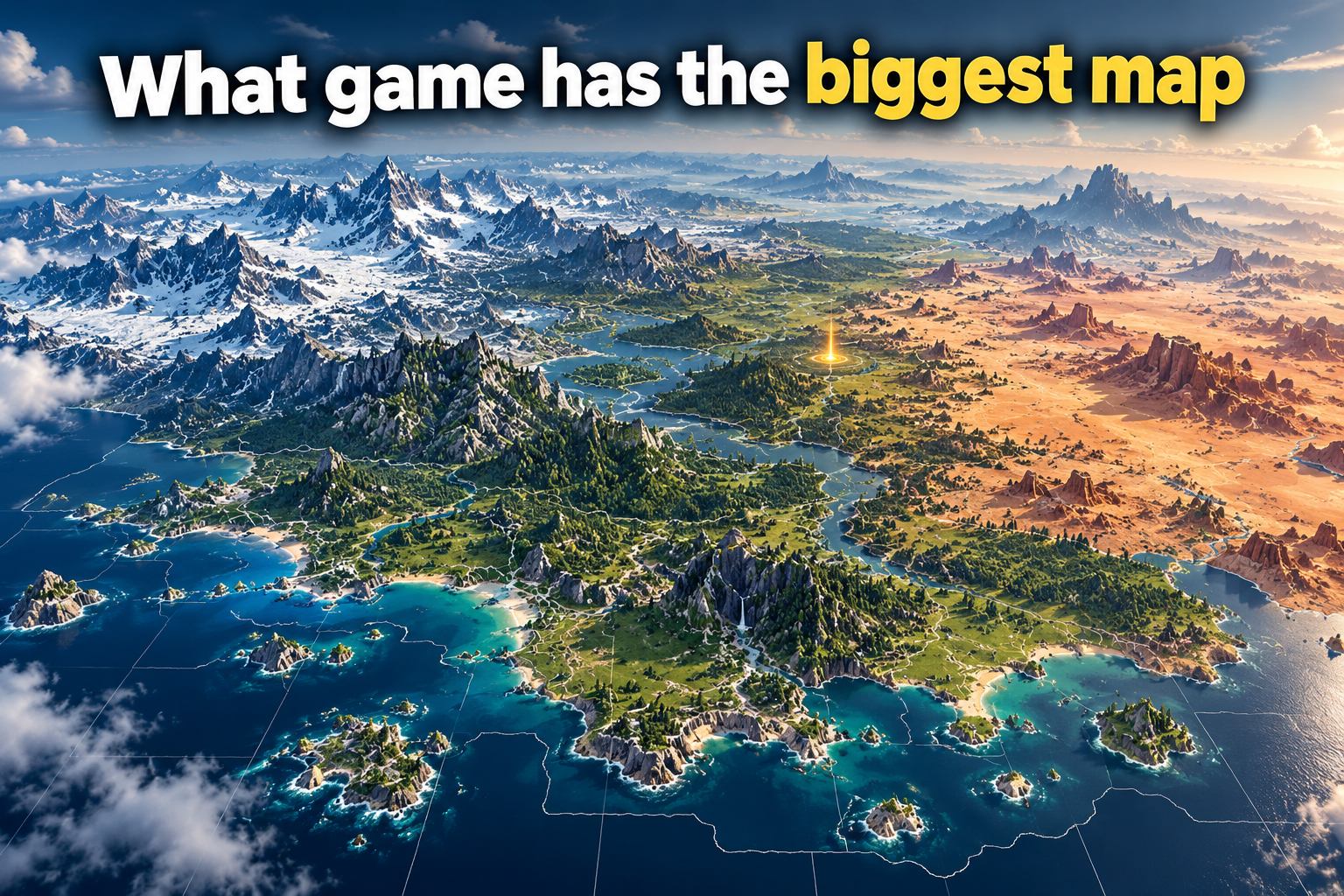
If you are wondering what game has the biggest map, the simplest answer is No Man’s Sky. Its procedurally generated universe contains more than 18 quintillion planets, making its explorable space vastly larger than the world of any conventional open-world game.
However, map-size comparisons are not as simple as they first appear. Some games generate almost endless environments through algorithms, while others provide one fixed landmass designed by developers. A game can also have an enormous theoretical boundary without giving players meaningful activities across the entire area.
This guide explains which titles lead the major map-size categories, how developers create such enormous worlds, and why raw area does not always produce better exploration. It also compares No Man’s Sky, Minecraft, Fuel, The Elder Scrolls II Daggerfall, and other famous examples.
No Man’s Sky has the biggest overall explorable game universe. Hello Games uses procedural generation to support more than 18 quintillion planets spread across numerous galaxies. Players can land on planets, explore their surfaces, enter caves, cross oceans, and fly into space.
The universe is not stored as one unimaginably large handcrafted file. Instead, mathematical rules generate terrain, plants, animals, weather, and other details when players visit an area. The same rules allow a previously discovered location to be generated consistently when someone returns.
Minecraft is another strong answer when the question is limited to one continuous terrestrial world. Its standard world extends roughly 30 million blocks from the center in each horizontal direction, producing an explorable area far larger than Earth’s surface if each block is treated as one meter.
Fuel is often mentioned when comparing fixed maps. Its approximately 14,000-square-kilometer environment was recognized for having the largest playable area in a console game at the time of its release. Unlike a universe containing generated planets, Fuel presents one connected region intended for vehicle travel.
The correct answer therefore depends on the category. No Man’s Sky wins for total explorable scale, Minecraft is a leading example of a huge continuous generated world, and Fuel remains a notable contender among finite driving environments.
How Is The Biggest Game Map Measured?
1. Total Playable Surface Area
The most familiar method calculates the number of square kilometers or square miles that players can physically cross. This approach works well for fixed open worlds such as Fuel or Grand Theft Auto V. It becomes less reliable when a game contains multiple planets, separate dimensions, inaccessible terrain, or endlessly generated regions.
2. Continuous World Size
A continuous-world measurement asks how far players can travel without selecting another level or teleporting to a disconnected area. Minecraft performs exceptionally well under this definition because most of its Overworld is one connected environment. Loading chunks during travel does not normally break the feeling of moving through a single world.
3. Procedural Generation Limits
Procedural games build locations from algorithms rather than storing every feature individually. They may offer billions of possible destinations while occupying a manageable amount of storage space. Their advertised size usually describes how many places the system can generate, not how much terrain was manually modeled and saved by the development team.
4. Handcrafted Versus Generated Terrain
Handcrafted maps are deliberately arranged by designers, whereas generated maps rely heavily on reusable rules and assets. Directly comparing them can be misleading. A smaller handcrafted world may contain more unique stories and memorable landmarks per kilometer, while a generated universe offers greater freedom, unpredictability, and long-distance exploration.
5. Horizontal And Vertical Space
Published map comparisons often focus only on horizontal surface area. That can undervalue games with tall mountains, deep oceans, underground networks, interiors, or multiple layers. Minecraft illustrates this issue clearly because its caves, structures, Nether dimension, and vertical building space add substantial playable volume beyond a flat overhead measurement.
6. Travel Time Across The Map
Crossing time offers a practical alternative to square kilometers. Reviewers may walk, drive, sail, or fly from one boundary to another and record the journey. Results still depend on vehicle speed, terrain, obstacles, fast travel, and the selected route, so crossing time should support rather than replace physical measurements.
7. Meaningful Explorable Content
A useful comparison also asks how much of the world rewards exploration. Empty terrain technically increases map size but may add little to the experience. Activities, settlements, resources, environmental variety, and surprising discoveries help determine whether an enormous map feels like a convincing world or merely a large distance between objectives.
Which Games Have The Largest Maps?
1. No Man’s Sky leads in total scale because its generated universe supports more than 18 quintillion planets. Seamless movement from space to many planetary surfaces makes those locations genuine playable destinations rather than decorative backgrounds. No person could explore more than a tiny fraction of the available universe.
2. Minecraft offers a gigantic continuous Overworld that can extend about 60 million blocks from one side to the other. Assuming one block represents roughly one meter, its horizontal area is several times larger than Earth’s surface. Most players will never approach its distant world boundary during normal play.
3. Fuel contains about 14,000 square kilometers of roads, plains, forests, and damaged landscapes built for high-speed travel. Its large dimensions suit an off-road racing game because vehicles can cross open terrain quickly. The map would feel considerably slower and emptier if it were designed mainly for walking.
4. The Elder Scrolls II Daggerfall is commonly estimated to cover roughly 160,000 square kilometers, although estimates vary according to methodology. Its settlements, wilderness, and dungeons rely heavily on procedural systems. The scale remains remarkable, but the older design produces a different kind of exploration from modern handcrafted role-playing games.
5. Elite Dangerous models the Milky Way with an enormous number of star systems and therefore rivals No Man’s Sky in astronomical scope. The comparison depends on what counts as map area, because much of its playable space involves interstellar travel rather than walking across planetary terrain. It is best treated as a separate space-simulation category.
Why Do Large Game Maps Matter?
- Freedom Of Exploration: Large maps let players choose their own direction instead of following one narrow route. That freedom supports curiosity and makes discoveries feel personal.
- Long-Term Replay Value: Generated worlds can provide new regions, resources, and situations across repeated sessions. Players are less likely to memorize every destination or exhaust the environment quickly.
- A Strong Sense Of Scale: Long journeys can make mountains, oceans, planets, and remote settlements feel genuinely distant. Scale supports immersion when travel remains interesting and matches the game’s theme.
- Player-Created Stories: Unexpected encounters often happen between planned objectives. Getting lost, surviving a storm, discovering an unusual planet, or building in an isolated location can become a memorable personal story.
- Room For Different Activities: A broad world can accommodate racing, building, survival, trading, combat, and quiet exploration. Different regions may serve different play styles without forcing every player into identical routines.
- Community Discovery: Huge maps encourage players to document rare locations and share unusual findings. Communities can continue uncovering secrets long after release, especially when procedural generation produces uncommon combinations.
What Should Players Consider Before Choosing?
1. Decide What Kind Of Scale You Want
Choose whether you want one continuous landscape, a collection of planets, or a realistic galaxy. Minecraft favors construction within a vast terrestrial world, No Man’s Sky emphasizes planetary discovery, and Fuel focuses on driving. All are large, but they create very different experiences.
2. Look Beyond Advertised Numbers
A huge figure is impressive, but it does not describe the quality of individual locations. Examine environmental variety, mission design, wildlife, settlements, and available activities. A smaller world filled with distinctive places may suit you better than a larger environment assembled from repeating components.
3. Consider The Main Travel Method
Map dimensions should be judged alongside movement speed. Thousands of square kilometers are reasonable when players use spacecraft or fast vehicles. The same distance may become tedious on foot. Good world design balances scale with transportation, navigation tools, rest points, and discoveries placed along common routes.
4. Check Whether Exploration Has Rewards
Before choosing a large open-world game, consider what you gain from leaving the main path. Useful materials, stories, creatures, views, equipment, or building locations make travel worthwhile. If distant areas provide nothing new, the impressive map may function mostly as empty space between meaningful destinations.
5. Match The Game To Your Available Time
Enormous worlds often suit players who enjoy gradual progress and self-directed goals. Someone with limited gaming time may prefer a denser map with clear objectives and quick travel. You never need to complete every region, but the expected pace should fit the way you normally play.
6. Expect Some Repetition In Generated Worlds
Procedural generation creates extraordinary scale by recombining systems, terrain rules, and asset sets. Familiar patterns will eventually appear, even when individual locations differ. Players who enjoy collecting, building, survival, and emergent events may accept that repetition more readily than those seeking entirely handcrafted stories.
7. Compare Density As Well As Area
Content density describes how frequently meaningful locations, challenges, or decisions appear. Large maps are most successful when quiet travel supports atmosphere without overwhelming the engaging parts. Comparing density helps explain why two worlds with similar dimensions can feel dramatically different during actual play.
No Man’s Sky is the strongest overall answer to what game offers the largest explorable map. Its procedurally generated universe of more than 18 quintillion planets operates on a scale that conventional open worlds cannot match.
Minecraft leads many discussions about enormous continuous generated landscapes, while Fuel and Daggerfall remain important examples in finite-map and classic role-playing comparisons. Each result changes slightly according to whether the measurement uses surface area, connected terrain, planets, or star systems.
Map size is only one part of a good open world. Travel options, variety, useful discoveries, and content density determine whether that space remains enjoyable. The best choice is ultimately the world whose activities make you want to continue exploring.
FAQs About The Biggest Game Maps
1. Does No Man’s Sky Have The Biggest Map?
Yes, No Man’s Sky is generally the best answer when total explorable scale is considered. Its procedural system supports more than 18 quintillion planets across multiple galaxies. Because players can visit planetary surfaces rather than merely viewing them from a distance, they count as playable environments.
2. Is Minecraft Bigger Than No Man’s Sky?
Minecraft has an enormous continuous world, but it is not larger than the combined planetary universe of No Man’s Sky. Minecraft may be the better comparison when discussing one connected land-based map. No Man’s Sky wins when all explorable planets and space regions are considered together.
3. What Game Has The Biggest Fixed Map?
The answer depends on whether older procedurally assembled worlds and specialized simulations are included. Fuel is one of the most famous examples, offering approximately 14,000 square kilometers in a connected driving environment. Daggerfall is often estimated to be much larger, although much of its world uses procedural design.
4. Can Players Explore Every No Man’s Sky Planet?
No. The number of planets is so large that exploring all of them is practically impossible. Even visiting one planet every second would require far longer than human civilization has existed. The scale is intended to preserve discovery and ensure that countless locations remain unvisited.
5. Are Procedurally Generated Maps Truly Infinite?
Most are not mathematically infinite. They usually have technical boundaries determined by coordinates, numerical limits, storage systems, or generation seeds. Developers may describe them as effectively infinite because normal players cannot reasonably reach or explore every possible area during a lifetime.
6. Does A Bigger Map Make A Game Better?
Not automatically. Large maps provide freedom and a sense of scale, but they can also feel repetitive or empty. A successful open world combines size with rewarding exploration, varied environments, convenient movement, and meaningful activities. Many smaller maps feel richer because their content is more concentrated.